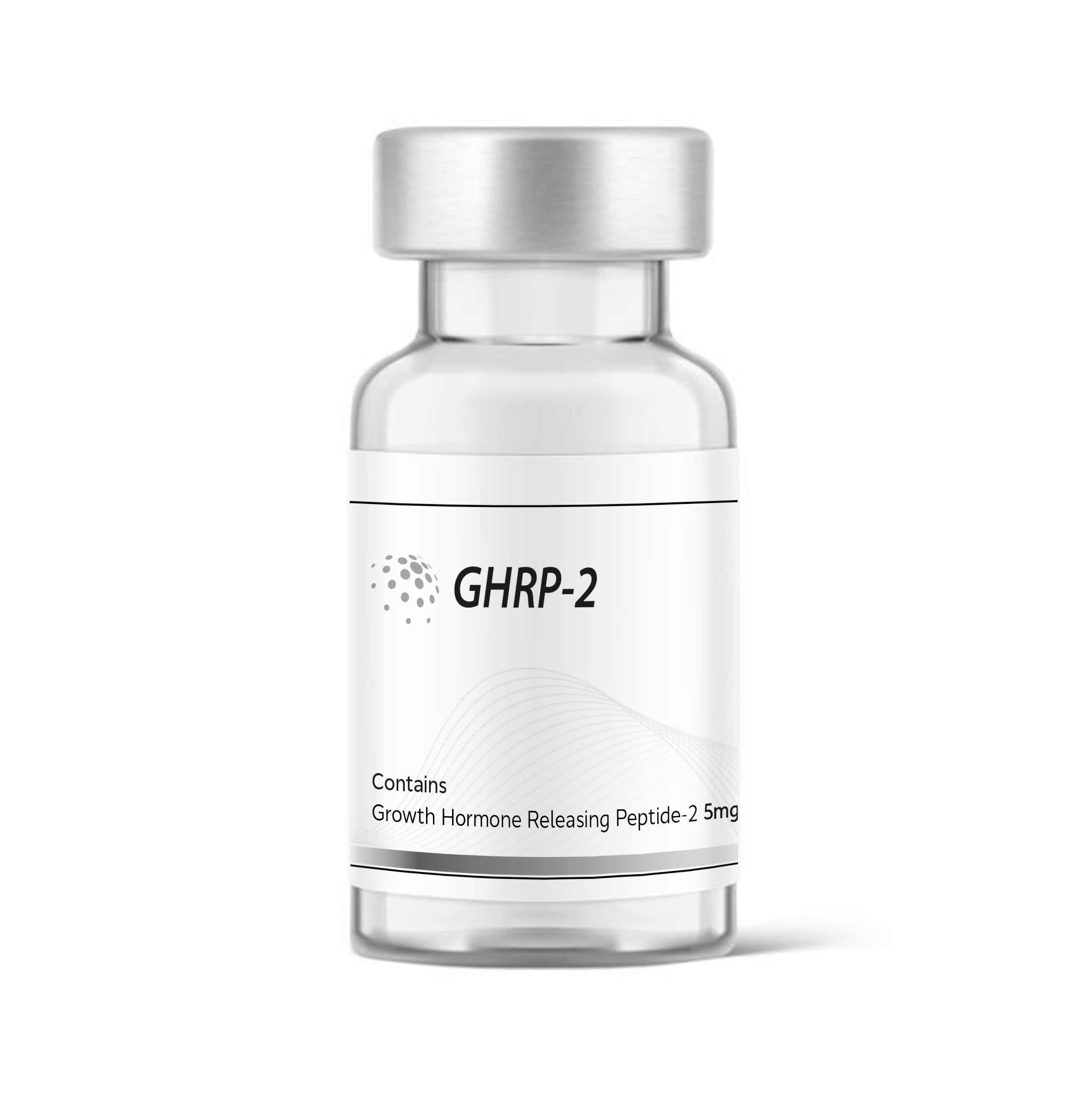
Description
GHRP-2
| Benefit | Key take-aways |
|---|---|
| 1 Physiologic GH pulsatility restoration | Nightly SC or intranasal GHRP-2 normalises age-blunted nocturnal GH peaks without sustained IGF-1 over-elevation, preserving feedback integrity. |
| 2 Appetite & weight gain in cachexia | As a ghrelin mimetic, GHRP-2 increases hunger and caloric intake; short trials in cancer/cachectic COPD show 2–3 kg lean-mass gain in 4–6 weeks. |
| 3 Muscle protein synthesis | Rodent hind-limb unloading plus GHRP-2 preserved solesus CSA and myofibrillar protein FSR, indicating anti-atrophic potential via GH/IGF-1 and intrinsic GHSR. |
| 4 Bone-density support | Daily peptide raised serum osteocalcin and improved tibial BMD by 6 % in ovariectomised rats—mirroring GH anabolic actions. |
| 5 Sleep-architecture enhancement | Bedtime dosing augments slow-wave sleep (SWS) and REM density, correlating with GH surges and next-day vigilance in middle-aged volunteers. |
| 6 Gastro-intestinal mucosal healing | GHRP-2 accelerates gastric and colonic ulcer closure via anti-apoptotic and angiogenic effects independent of GH. |
| 7 Cardio-protection signal | Pre-ischaemic infusion limits infarct size and preserves ejection fraction in rat I/R models, linked to PI3K–Akt–eNOS activation. |
| 8 Immune-modulation | Peptide attenuates LPS-induced TNF-α/IL-6 release while sparing anti-viral IFN pathways, suggesting sepsis-adjunct potential. |
| 9 Insulin-sensitivity drift (caution) | Repeated dosing can raise fasting glucose 5–10 mg dL⁻¹ via counter-regulatory hormones—monitor glycaemia, especially in pre-diabetes. |
2. Molecular Mechanism of Action
2.1 Receptor Pharmacodynamics
GHRP-2 binds GHSR-1a (a GPCR) on hypothalamic neurons and pituitary somatotrophs → Gαq/11–PLC–IP₃/Ca²⁺ cascade → GH vesicle exocytosis. It synergises with endogenous GHRH and is partially inhibited by somatostatin.
2.2 Down-stream Biology
| Pathway | Functional outcome | Context |
|---|---|---|
| GH → GHR–JAK2–STAT5 | ↑ IGF-1, lipolysis, protein synthesis | Liver, adipose, muscle |
| Ghrelin–AMPK | ↑ appetite, gastric motility, GH release | Hypothalamus, GI tract |
| PI3K–Akt–eNOS (extra-pituitary) | Anti-apoptotic, vasodilatory, cardio-protective | Myocardium, endothelium |
3. Pharmacokinetics
-
Absorption: Effective IV, SC, intranasal, sublingual; oral bioavailability negligible.
-
Half-life: Plasma t½ 20–30 min; GH peak ~30 min post-dose, back to baseline by 2 h.
-
Distribution/Clearance: Rapid renal/hepatic peptide degradation; no CYP interactions.
4. Pre-clinical and Translational Evidence
4.1 Cachexia & Sarcopenia
Phase 2 pilot in cancer cachexia showed ↑ caloric intake, lean mass, QOL over 30 days; COPD cohort mirrored gains with functional strength uptick.
4.2 Endocrine Diagnostics
0.5 µg kg⁻¹ IV bolus provokes ≥3-fold GH rise in healthy adults; blunted response signals pituitary impairment—approved diagnostic in Japan.
4.3 Sleep & Cognition
Nightly intranasal GHRP-2 restored SWS percentage and improved Stroop and digit-span performance after 3 weeks in adults >50 y.
4.4 Metabolic & Cardiovascular
Rodent DIO studies recorded visceral-fat reduction despite appetite increase, attributed to GH-driven lipolysis; cardiac I/R models showed smaller infarcts and better hemodynamics.
5. Emerging Clinical Interests
| Field | Rationale | Current status |
|---|---|---|
| Cancer/COPD cachexia | Appetite + GH anabolic synergy | Phase 2 pilots; larger RCTs planned |
| Sarcopenic obesity | GH pulses without chronic IGF-1 excess | Exploratory studies |
| Sleep disorders (mid-life SWS loss) | GHRP-2 augments SWS & GH | Proof-of-concept trials |
| Diagnostic endocrinology | Rapid GH provocative test | Approved in JP; investigational elsewhere |
6. Safety and Tolerability
-
Common: Transient flushing, paresthesia, hunger surges, mild headache.
-
Hormonal drift: Prolactin & cortisol peaks (~1.5 × baseline 30 min) resolve by 2 h.
-
Metabolic: Watch for mild fasting-glucose rise; adjust antidiabetics if needed.
-
CV: Occasional palpitations; no sustained QT issues in studies <12 weeks.
-
Contra-indications: Active malignancy under anabolic-sensitive evaluation, uncontrolled diabetes, pregnancy.
Comparative safety matrix
| Concern | GHRP-2 (GHSR agonist) | Tesamorelin (GHRH analog) | MK-677 (oral GHSR agonist) |
|---|---|---|---|
| IGF-1 elevation | Moderate, pulsatile | Physio-range | Higher, sustained |
| Appetite impact | ↑↑ (orexigenic) | Neutral | ↑ |
| Glucose drift | Mild ↑ | Neutral–mild ↑ | Moderate ↑ |
| Prolactin/cortisol spike | Yes (transient) | Minimal | Yes |
| Admin route | IV/SC/IN | SC daily | Oral daily |
7. Regulatory Landscape
-
Japan: Pralmorelin IV approved (1999) for GH-deficiency diagnostics.
-
US/EU: Investigational/research use only; compounded peptides circulate without FDA evaluation.
-
Sport: WADA-prohibited as a GH-secretagogue (S2 class).
8. Future Directions
-
Long-acting analogs or lipidated depots to minimise injection frequency.
-
Combination regimens with resistance exercise or anti-catabolic agents in cachexia trials.
-
Metabolic tuning: Co-administration with GLP-1RA to offset orexigenic effect while retaining GH surge.
-
Biomarker-guided dosing: Use IGF-1 SDS and continuous glucose monitoring to individualise therapy.
-
Cardio-metabolic endpoints: Larger animal → human translation for post-MI remodelling and HFpEF.