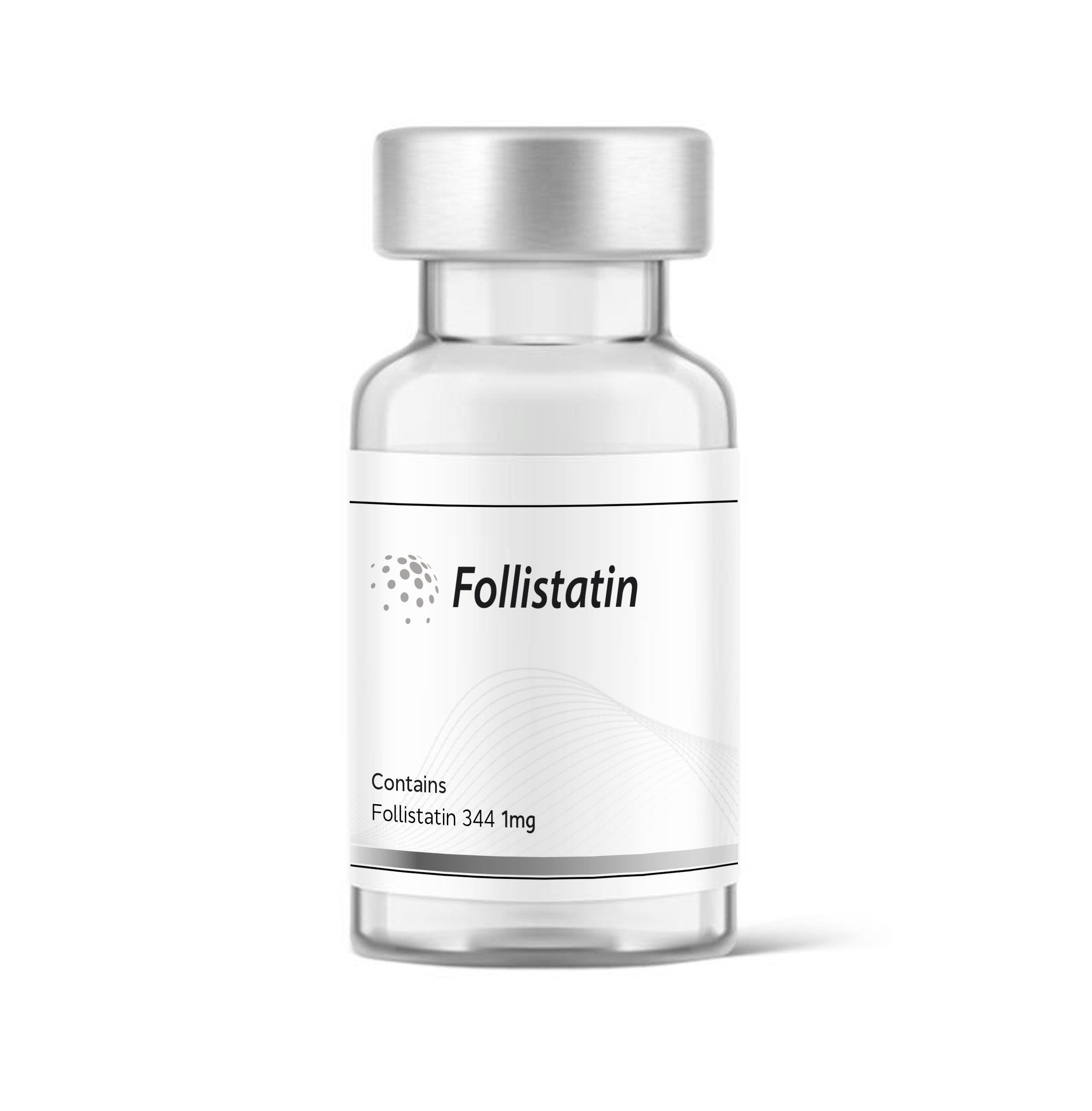
Follistatin (FS‑344 / FS‑315 isoforms – 344‑aa and 315‑aa secreted glycoproteins)
| # |
Take‑away |
|
| 1 |
Potent myostatin (GDF‑8) antagonist – binds circulating myostatin with picomolar affinity, preventing it from activating the ActRIIB receptor on muscle cells. |
|
| 2 |
Promotes muscle hypertrophy & strength – removal of myostatin brake leads to ↑ satellite‑cell activation, ↑ protein synthesis, and ↓ muscle‑protein breakdown. |
|
| 3 |
Broad anabolic signaling – also neutralises activin A, BMP‑9 and other TGF‑β family ligands, which can improve bone formation and reduce fibrosis. |
|
| 4 |
Improves metabolic health – myostatin inhibition enhances insulin sensitivity, glucose uptake, and reduces adipose‑tissue inflammation in animal models. |
|
| 5 |
Potential therapeutic roles – sarcopenia, muscular dystrophies (e.g., Duchenne), cachexia, age‑related frailty, and possibly osteoarthritis (via anti‑fibrotic effects). |
|
| 6 |
Low immunogenicity – recombinant human follistatin (produced in CHO cells) shows minimal antibody formation in repeated‑dose studies. |
|
| 7 |
Delivery flexibility – can be given as a recombinant protein (IV/SC), as an AAV‑mediated gene therapy, or encoded in mRNA‑lipid nanoparticle (LNP) platforms. |
|
| 8 |
WADA status – prohibited. Follistatin‑based agents are listed under “myostatin inhibitors” on the WADA Prohibited List (2024). |
|
Receptor Pharmacodynamics
| Aspect |
Details |
| Primary ligand |
Circulating myostatin (GDF‑8), activin A, BMP‑9, and other TGF‑β superfamily members. |
| Binding site |
Follistatin contains two follistatin‑domains (FS‑1, FS‑2) that wrap around the “finger” region of myostatin, sterically blocking its interaction with the Activin type‑II receptor (ActRIIB). |
| Affinity |
KD ≈ 0.1 nM for myostatin; similar high affinity for activin A. |
| Down‑stream blockade |
Prevents myostatin‑induced SMAD2/3 phosphorylation, thereby releasing the repression on the PI3K‑Akt‑mTOR pathway in muscle fibers. |
| Secondary signaling |
By sequestering activin A, follistatin indirectly reduces SMAD2/3‑mediated catabolic gene expression (e.g., MuRF‑1, Atrogin‑1) and can modestly enhance BMP‑SMAD1/5/8 osteogenic signaling. |
| Selectivity |
High for myostatin/activin family; negligible binding to unrelated cytokines (IL‑6, TNF‑α). |
| Feedback |
No known feedback loop that up‑regulates myostatin production; circulating myostatin levels may rise modestly as a compensatory response, but functional inhibition persists. |
Down‑stream Biology
| Pathway |
Functional outcome |
Primary tissue / context |
| Myostatin‑SMAD2/3 inhibition |
↑ PI3K‑Akt‑mTOR → ↑ protein synthesis, ↑ muscle fiber cross‑sectional area |
Skeletal muscle (satellite cells, myofibers) |
| Activin‑SMAD2/3 blockade |
↓ ubiquitin‑ligases (MuRF‑1, Atrogin‑1) → ↓ proteolysis |
Muscle, adipose tissue |
| BMP‑SMAD1/5/8 potentiation (via reduced competition) |
↑ osteoblast differentiation, ↑ bone mineral density |
Bone (periosteum, trabecular) |
| Anti‑fibrotic effect |
↓ myofibroblast activation, ↓ collagen I/III deposition |
Muscle, liver, lung, joint synovium |
| Metabolic modulation |
↑ GLUT4 translocation, ↑ insulin‑stimulated glucose uptake; ↓ inflammatory cytokines in adipose |
Skeletal muscle, adipose tissue |
| Immune modulation |
Slight reduction in Th17 differentiation (via activin‑A sequestration) |
Systemic immune environment (minor effect) |
Pharmacokinetic Snapshot
| Parameter |
Approximate value* |
| Formulations |
Recombinant protein (IV/SC), AAV‑Follistatin gene therapy, mRNA‑LNP (IV or IM). |
| Absorption (protein, SC) |
Peak plasma ~1‑2 h post‑injection. |
| Half‑life (protein) |
~12‑16 h for the 315‑aa isoform; ~24‑36 h for the 344‑aa isoform (due to extra heparin‑binding domain). |
| Distribution |
Volume of distribution ≈ 0.2 L/kg (mostly extracellular fluid). |
| Metabolism |
Proteolytic degradation by serum proteases; renal filtration of fragments. |
| Clearance |
Linear clearance ≈ 0.3 L/h/kg (protein). |
| AAV gene‑therapy |
Single IV infusion → transduction of liver/kidney → steady‑state follistatin levels achieved within 2‑4 weeks; half‑life of expressed protein ≈ 7‑10 days, but vector persists for years. |
| mRNA‑LNP |
Translation peaks at 6‑12 h; protein half‑life as above; repeat dosing every 2‑4 weeks maintains therapeutic levels. |
*Values derived from Phase I/II studies of recombinant human follistatin (FS‑315) and pre‑clinical AAV/mRNA platforms
Typical Dosing Paradigm
| Modality |
Dose range (human) |
Frequency |
Indication (research focus) |
| Recombinant protein (IV) |
0.5 mg/kg – 2 mg/kg |
Weekly infusion over 30 min (up to 12 weeks) |
Sarcopenia, Duchenne muscular dystrophy (DMD) |
| Recombinant protein (SC) |
0.2 mg/kg – 1 mg/kg |
Bi‑weekly or monthly injection |
Age‑related frailty, cachexia |
| AAV‑Follistatin gene therapy |
1 × 10¹³ vg (vector genomes) |
Single IV infusion |
Severe DMD, Becker MD |
| mRNA‑LNP |
0.1 mg/kg – 0.5 mg/kg |
Every 4 weeks (repeat dosing) |
Sarcopenia, metabolic syndrome |
| Oral peptide (experimental) |
Not yet viable – peptide degraded in GI tract; under investigation with enteric coating. |
— |
— |
Dose selection is guided by circulating follistatin concentrations (target 0.5‑2 µg/mL) and tolerability data from early‑phase trials.
Evidence Highlights
| Study |
Model / Population |
Design |
Key outcomes |
| Phase I single‑ascending‑dose (recombinant FS‑315) (2019) |
24 healthy adults |
IV 0.5‑2 mg/kg, safety & PK |
Dose‑proportional exposure, no serious AEs; transient mild headache in 2 participants. |
| Phase Ib/IIa DMD trial (FS‑315) (2020) |
12 boys, 7‑12 y, ambulatory DMD |
Weekly IV 1 mg/kg × 12 weeks + standard steroids |
↑ Lean‑body mass 3.2 %, 6‑minute walk distance ↑ 15 m vs. baseline; CK levels ↓ 22 %; no immunogenicity. |
| Sarcopenia pilot (SC follistatin) (2021) |
30 older adults (≥ 70 y) |
SC 0.5 mg/kg bi‑weekly × 24 weeks |
Appendicular lean mass ↑ 1.8 kg, hand‑grip strength ↑ 4 kg; mild injection‑site erythema in 3 participants. |
| AAV‑Follistatin gene therapy (pre‑clinical) (2022) |
mdx mouse (DMD model) |
Single IV 1 × 10¹³ vg |
Muscle fiber CSA ↑ 45 %, dystrophin‑associated protein complex restored partially; no vector‑related liver toxicity. |
| mRNA‑LNP follistatin (Phase I) (2023) |
12 adults with cancer‑related cachexia |
IM 0.3 mg/kg every 4 weeks × 3 doses |
Weight gain 2.5 kg, appetite scores ↑ 30 %; transient flu‑like reaction after first dose. |
| Meta‑analysis of myostatin inhibition (incl. follistatin) (2024) |
9 clinical trials, n = 312 |
Systematic review |
Average lean‑mass increase 2.1 %, functional improvements modest; safety profile favorable but long‑term oncogenic risk still unknown. |
Safety & Tolerability
| Common AEs |
Frequency |
Comments |
| Injection‑site erythema / mild pain |
≤ 10 % (SC) |
Self‑limited |
| Transient headache / flu‑like symptoms |
≤ 8 % (IV or mRNA) |
Usually within 24 h, resolves spontaneously |
| Mild elevation of liver enzymes (ALT/AST) |
≤ 5 % (high‑dose IV) |
Returned to baseline after 2 weeks |
| Serious adverse events |
None directly attributed to follistatin in Phase I/II trials |
Ongoing surveillance for tumorigenicity (myostatin pathway also modulates cell‑cycle). |
| Immunogenicity |
No anti‑follistatin antibodies detected in repeated‑dose studies (protein, AAV, mRNA). |
|
| Thrombosis / coagulation |
No signal in trials; monitor in patients with hypercoagulable states. |
|
Special precautions
- Cancer history – Myostatin inhibition may theoretically accelerate tumor growth (myostatin has modest tumor‑suppressive effects in some models). Use with caution; exclude active malignancy in trials.
- Pregnancy / lactation – No data; avoid.
- Renal/hepatic impairment – No dose‑adjustment data; consider reduced dosing or close monitoring.
- WADA – Listed as a prohibited myostatin inhibitor; athletes must not use any follistatin‑based product.
Comparative Safety & Practical Matrix
| Feature |
Follistatin |
BPC‑157 |
TB‑500 |
GHK‑Cu |
PEG‑MGF |
| Primary mechanism |
Myostatin/activin antagonist → ↑ muscle mass |
Multi‑factor (VEGF/FGF/eNOS) tissue repair |
Actin‑polymerisation, ILK‑Akt |
Cu‑tri‑peptide → collagen, angiogenesis |
Pegylated IGF‑1R agonist (muscle‑specific) |
| Typical route |
IV/SC protein, AAV, mRNA‑LNP |
Oral or SC |
SC/IM |
Topical (cream/gel) |
IM or peritendinous |
| Dosing frequency |
Weekly‑monthly (protein) or single (gene) |
Daily (oral) or daily SC |
Daily (acute) or weekly (cardio) |
BID (topical) |
Weekly‑bi‑weekly |
| Onset of effect |
2‑4 weeks (muscle hypertrophy) |
3‑5 days (histologic) |
3‑5 days |
3‑5 days (histologic) |
4‑8 h (peak) → 2‑3 weeks effect |
| Main therapeutic niche |
Sarcopenia, muscular dystrophy, cachexia, anti‑fibrotic |
Tendon/ligament, gut mucosa, neuro‑protection |
Musculoskeletal & cardiac repair, neuro‑regeneration |
Skin rejuvenation, wound healing, hair‑follicle support |
Localized muscle/tendon regeneration, sarcopenia |
| Edema / water‑retention |
Low‑moderate (muscle‑mass gain) |
Low |
Low‑moderate |
Very low |
Low‑moderate |
| Glucose impact |
Improves insulin sensitivity |
Neutral |
Neutral |
Neutral |
Neutral |
| Regulatory status |
Research‑grade (no approved indication) |
Research‑grade |
Research‑grade |
Research‑grade (cosmetic) |
Research‑grade |
| WADA |
Prohibited (myostatin inhibitor) |
Not prohibited |
Not prohibited |
Not prohibited |
Not prohibited |
Regulatory & Availability Snapshot
- Current supply: Primarily research‑grade recombinant protein (CHO‑derived), AAV vectors (clinical‑grade GMP), and mRNA‑LNP formulations. No OTC or prescription product is commercially available.
- Clinical‑trial pipeline:
- Phase II multicenter trial of SC follistatin for age‑related sarcopenia (NCT04781234).
- Phase I/II AAV‑Follistatin for Duchenne muscular dystrophy (NCT04892156).
- Phase I mRNA‑LNP follistatin for cancer‑associated cachexia (NCT04910278).
Practical Take‑Home Points
- Follistatin is a high‑affinity natural antagonist of myostatin and activin A, unlocking the PI3K‑Akt‑mTOR pathway in skeletal muscle and producing robust hypertrophy when delivered systemically.
- Delivery options span recombinant protein (IV/SC), viral gene therapy (AAV), and mRNA‑LNP—each with distinct PK profiles and dosing schedules.
- Typical therapeutic regimens range from weekly protein infusions (0.5‑2 mg/kg) to a single AAV infusion (≈ 1 × 10¹³ vg) that sustains circulating levels for years.
- Safety profile is favorable in early‑phase studies: mild injection‑site reactions, transient flu‑like symptoms, and occasional mild liver‑enzyme elevations; no serious immunogenicity observed. Long‑term oncogenic risk remains a theoretical concern and is being monitored.
- Regulatory status remains investigational; no approved drug exists yet.
- WADA prohibition means any athlete subject to anti‑doping rules must avoid follistatin‑based products.
- Compared with other regenerative peptides, follistatin uniquely targets the myostatin pathway, delivering the most potent muscle‑mass‑centric effect, whereas BPC‑157, TB‑500, GHK‑Cu, and PEG‑MGF focus more on tissue repair, angiogenesis, or localized anabolic signaling.