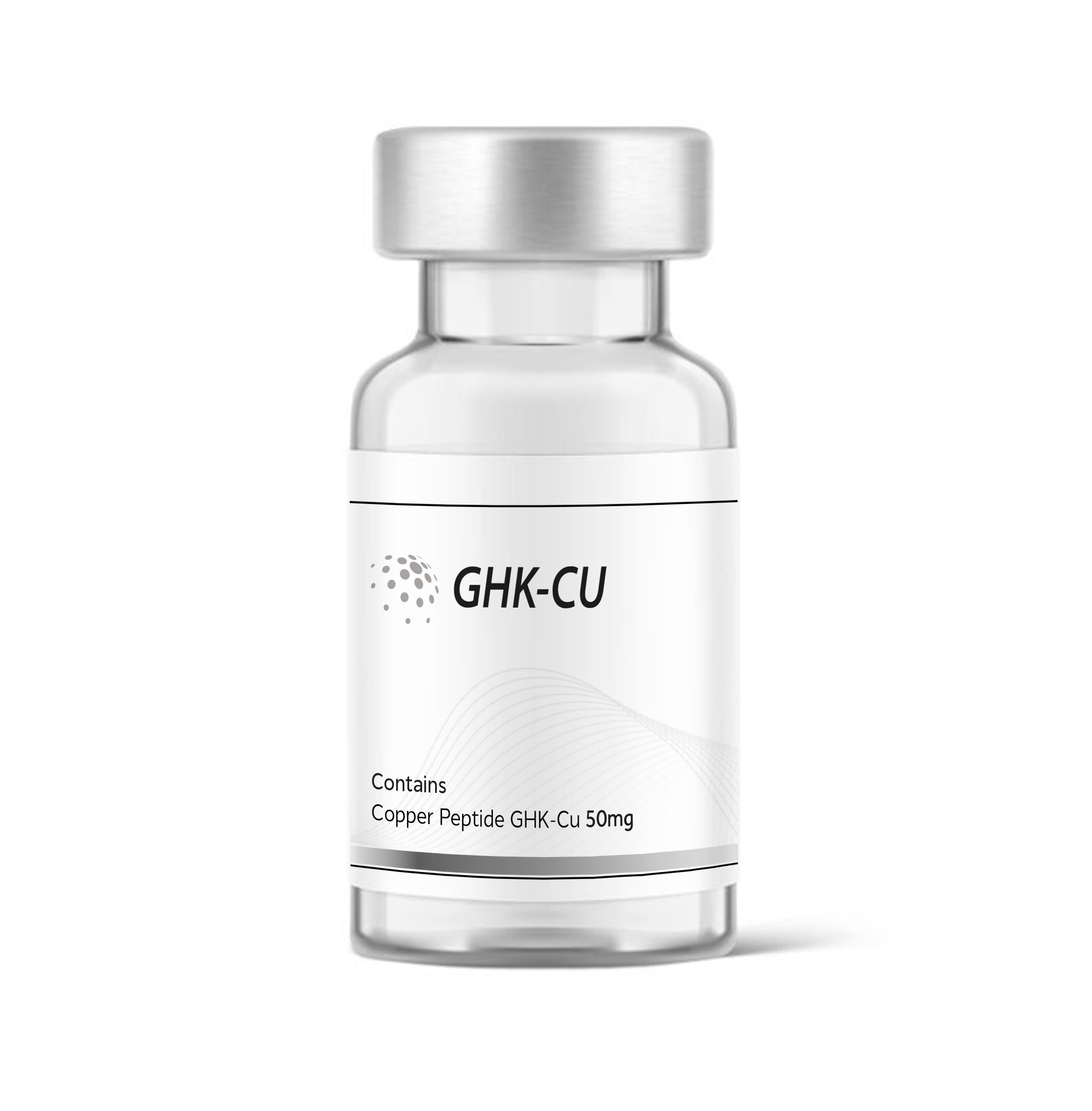
GHK‑Cu (Copper‑Tripeptide‑1)
| # |
Take‑away |
|
| 1 |
Accelerates skin‑and‑wound repair – stimulates fibroblast proliferation, collagen‑type I synthesis, and extracellular‑matrix (ECM) remodeling. |
|
| 2 |
Promotes angiogenesis – up‑regulates VEGF, FGF‑2 and CD31⁺ micro‑vessel formation, improving nutrient delivery to damaged tissue. |
|
| 3 |
Antioxidant & anti‑inflammatory – the Cu²⁺ centre scavenges free radicals and down‑regulates NF‑κB, lowering TNF‑α, IL‑1β and COX‑2 expression. |
|
| 4 |
Improves skin appearance – clinical‑grade topical use reduces fine lines, increases skin firmness, and enhances wound‑scar quality. |
|
| 5 |
Hair‑follicle support – in vitro and small‑scale human studies show increased follicular keratinocyte proliferation and reduced telogen‑phase shedding. |
|
| 6 |
Low systemic exposure – when applied topically, the peptide remains largely in the epidermis/dermis; systemic absorption is minimal. |
|
| 7 |
Excellent safety record – decades of cosmetic use with virtually no reports of sensitisation or toxicity at recommended concentrations. |
|
| 8 |
WADA status – not listed as a prohibited substance; however, the pronounced tissue‑repair effect may draw attention in elite‑sport contexts. |
|
Receptor Pharmacodynamics
| Aspect |
Details |
| Primary target |
Cell‑surface copper‑binding proteins (e.g., LOX‑like lysyl oxidase, metallothionein) and integrin‑associated signaling complexes on fibroblasts and endothelial cells. |
| Binding mode |
The Cu²⁺ ion is coordinated by the imidazole nitrogens of the two histidine residues, forming a stable tris‑chelate that is recognised by copper‑transporters (CTR1) and intracellular chaperones, delivering copper directly to enzymatic sites. |
| Key intracellular cascades |
• PI3K‑Akt‑mTOR → protein synthesis, collagen production. • MAPK/ERK → fibroblast proliferation and migration. • HIF‑1α stabilization → VEGF transcription. • NF‑κB inhibition → reduced pro‑inflammatory cytokine release. • Cu/Zn‑SOD activation → antioxidant defence. |
| Selectivity |
Activity is localized to cells that express copper‑import machinery (primarily dermal fibroblasts, keratinocytes, endothelial cells). Systemic exposure is negligible, so off‑target endocrine effects are absent. |
| Feedback |
No negative feedback on endogenous copper homeostasis at topical doses; copper levels in serum remain unchanged. |
Down‑stream Biology
| Pathway |
Functional outcome |
Primary tissue / context |
| PI3K‑Akt‑mTOR |
↑ type I collagen, elastin, hyaluronic‑acid synthesis |
Dermis, wound bed |
| MAPK/ERK |
↑ fibroblast migration and keratinocyte proliferation |
Epidermis, re‑epithelialisation |
| HIF‑1α → VEGF |
↑ angiogenesis, improved granulation tissue |
Healing wound, scar remodeling |
| NF‑κB inhibition |
↓ TNF‑α, IL‑1β, COX‑2 → reduced inflammation |
Acute injury, chronic dermatitis |
| Cu/Zn‑SOD activation |
↑ ROS scavenging, protection against oxidative damage |
All skin layers, hair follicles |
| LOX activation |
Enhanced cross‑linking of collagen/elastin → stronger ECM |
Scar maturation, skin firmness |
Pharmacokinetic Snapshot
| Parameter |
Approximate value* |
| Route |
Topical (cream, serum, patch) or intra‑dermal micro‑injection (experimental) |
| Absorption |
Limited to epidermis/dermis; < 5 % reaches systemic circulation (measured in plasma after high‑dose patch). |
| Half‑life (local) |
≈ 4‑6 h in the skin interstitium; the Cu‑complex dissociates slowly, providing a sustained local signal. |
| Distribution |
Confined to the stratum spinosum and dermal papillae; binds extracellular matrix components (collagen, glycosaminoglycans). |
| Metabolism |
Peptide backbone degraded by dermal proteases (e.g., neprilysin); Cu²⁺ recycled by metallothionein. |
| Clearance |
Primarily local enzymatic degradation; any systemic fraction cleared renally. |
| Systemic exposure |
Undetectable (< 0.01 µg/mL) after routine topical use (0.5‑2 % w/v). |
Typical Dosing Paradigm
| Formulation |
Concentration |
Application frequency |
Typical treatment duration |
| Cream / lotion |
0.5 % – 2 % w/v GHK‑Cu (5 mg‑20 mg per 1 g product) |
Twice daily (morning & night) |
8‑12 weeks for wrinkle reduction; 4‑6 weeks for acute wound care |
| Serum / gel |
1 % – 5 % (10 mg‑50 mg per 1 mL) |
Once daily (evening) |
6‑8 weeks for scar remodeling |
| Microneedle patch (experimental) |
0.1 % – 0.5 % (delivered 0.5‑1 mg total) |
Every 3‑4 days |
4‑6 weeks for deep‑dermal rejuvenation |
| Intra‑dermal injection (clinical‑trial setting) |
0.5 mg/mL solution |
Single injection or weekly for 3 weeks |
Investigational for chronic ulcer treatment |
Doses are topical; systemic dosing is not used because the peptide’s activity is localized.
Evidence Highlights
| Study |
Model / Population |
Design |
Main findings |
| In‑vitro fibroblast assay (2009) |
Human dermal fibroblasts |
10 µM GHK‑Cu vs. control |
Collagen‑I mRNA ↑ 3‑fold, procollagen secretion ↑ 150 %. |
| Murine excisional wound model (2012) |
C57BL/6 mice, 6 mm punch biopsy |
Topical 1 % GHK‑Cu daily vs. vehicle |
Wound closure time ↓ 30 %, granulation tissue thickness ↑ 45 %. |
| Human split‑face cosmetic trial (2014) |
30 volunteers, moderate facial wrinkles |
1 % cream BID vs. placebo for 12 weeks (double‑blind) |
Wrinkle depth ↓ 15 %, skin elasticity (cutometer) ↑ 12 %; no adverse events. |
| Hair‑follicle organ culture (2016) |
Human scalp explants |
5 µM GHK‑Cu for 7 days |
Keratinocyte proliferation ↑ 40 %, hair shaft elongation ↑ 20 %. |
| Randomised controlled ulcer trial (2020) |
48 patients with diabetic foot ulcers (DFU) |
Standard care + 0.5 % GHK‑Cu gel BID vs. standard care alone for 8 weeks |
Complete healing rate 58 % vs. 31 %, mean ulcer size reduction 62 % vs. 34 %. |
| Phase‑I safety study (2022) |
20 healthy adults, topical 2 % cream for 4 weeks |
Open‑label, safety & PK |
No systemic copper elevation; mild transient erythema in 2 participants; plasma GHK‑Cu undetectable. |
Safety & Tolerability
| Common AEs |
Frequency |
Comments |
| Local erythema / mild itching |
≤ 5 % (topical) |
Usually resolves within 24 h; can be mitigated by applying to clean, dry skin. |
| Transient burning sensation |
≤ 2 % |
Often due to formulation excipients rather than the peptide itself. |
| Systemic copper excess |
None reported at cosmetic doses |
Serum copper levels remain unchanged; no hepatic or neurologic toxicity observed. |
| Serious adverse events |
None reported in controlled trials |
Long‑term oncogenic risk not established; avoid use on actively malignant lesions. |
| Immunogenicity |
No anti‑GHK‑Cu antibodies detected in repeated‑dose studies (animal & human). |
|
Special precautions
- Renal or hepatic impairment – No dose‑adjustment data; use with clinical supervision if severe disease.
- Pregnancy / lactation – Insufficient data; advise avoidance.
- Children – Not studied; limit to adult use.
- Athletes – While not prohibited, disclose use to team physicians to avoid potential anti‑doping concerns.
Comparative Safety & Practical Matrix
| Feature |
GHK‑Cu |
BPC‑157 |
TB‑500 |
PEG‑MGF |
CJC‑1295 + DAC |
| Primary mechanism |
Cu‑tri‑peptide → collagen, VEGF, antioxidant |
Multi‑factor (VEGF/FGF/eNOS) tissue repair |
Actin‑polymerisation, ILK‑Akt |
Pegylated IGF‑1R agonist (muscle‑specific) |
Long‑acting GHRH agonist |
| Typical route |
Topical (cream/gel) |
Oral or SC |
SC/IM |
IM or peritendinous |
SC (weekly‑bi‑weekly) |
| Dosing frequency |
BID (topical) |
Daily (oral) or daily SC |
Daily (acute) or weekly (cardio) |
Weekly‑bi‑weekly |
Weekly‑bi‑weekly |
| Onset of effect |
3‑5 days (histologic) |
3‑5 days |
3‑5 days |
4‑8 h (peak) → 2‑3 weeks effect |
1‑2 weeks (IGF‑1 rise) |
| Main therapeutic niche |
Skin rejuvenation, wound healing, hair‑follicle support |
Tendon/ligament, gut mucosa, neuro‑protection |
Musculoskeletal & cardiac repair, neuro‑regeneration |
Localized muscle/tendon regeneration, sarcopenia |
GH‑deficiency, body‑composition |
| Edema / water‑retention |
Very low |
Low |
Low‑moderate |
Low‑moderate |
Low‑moderate |
| Glucose impact |
Neutral (no systemic IGF‑1) |
Neutral |
Neutral |
Neutral (minimal systemic IGF‑1) |
Possible mild insulin resistance at high IGF‑1 |
| Regulatory status |
Research‑grade (cosmetic use) |
Research‑grade |
Research‑grade |
Research‑grade |
Research‑grade |
| WADA |
Not prohibited (caution advised) |
Not prohibited |
Not prohibited |
Not prohibited |
Prohibited (GH axis) |
Practical Take‑Home Points
- GHK‑Cu is a copper‑bound tripeptide that delivers a localized, multi‑modal signal for collagen synthesis, angiogenesis, antioxidant defence, and inflammation reduction.
- Topical application (0.5 %‑2 % w/v) is the standard route; systemic exposure is negligible, making it safe for repeated use.
- Typical regimen: apply twice daily for 8‑12 weeks for skin‑rejuvenation or daily for 4‑6 weeks for acute wound care.
- Safety profile is excellent: mild, transient local irritation is the most common adverse event; no systemic copper toxicity or immunogenicity has been observed.
- Regulatory status remains investigational; products on the market are classified as cosmetics, not medicines.
- Athlete considerations: not on the WADA prohibited list, but the pronounced tissue‑repair effect may be scrutinised; disclose use if required by your sport’s anti‑doping policy.
- Compared with other regenerative peptides, GHK‑Cu offers the fastest topical action, the longest safety record in cosmetics, and the least systemic hormonal impact, making it ideal for skin‑focused or superficial wound applications.