Description
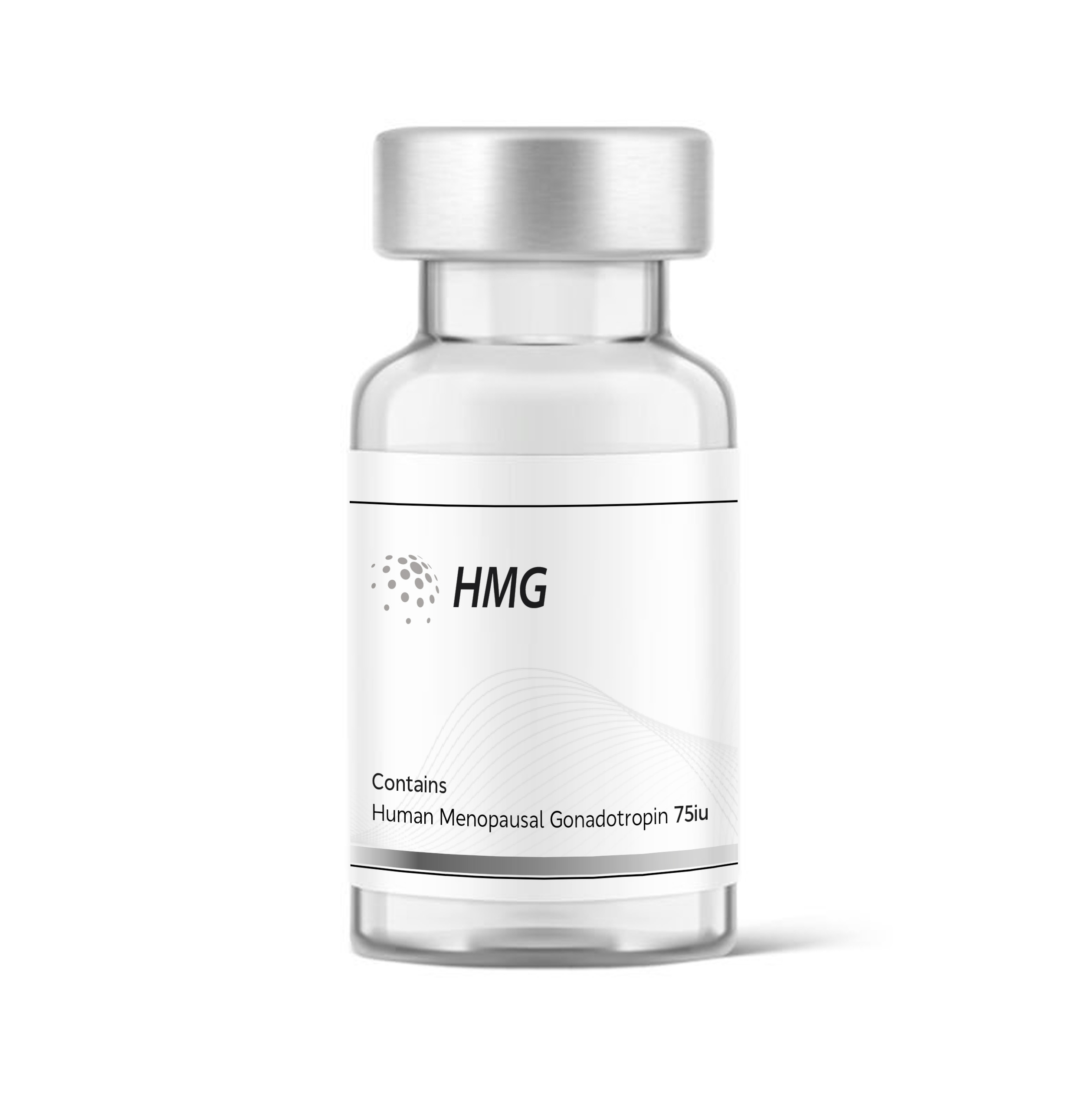
Human Menopausal Gonadotropin (HMG 75 IU)
Recombinant‑free, urinary‑derived preparation containing both follicle‑stimulating hormone (FSH) and luteinising hormone (LH) activity. Each vial supplies 75 IU of combined activity (≈ 37.5 IU FSH + 37.5 IU LH).
| # |
Point |
| 1 |
Dual‑gonadotropin – HMG provides physiologic ratios of FSH + LH, supporting follicular recruitment and the later luteinising surge needed for oocyte maturation. |
| 2 |
Indications – Ovulation induction in anovulatory women, controlled ovarian stimulation (COS) for intra‑uterine insemination (IUI) or in vitro fertilisation (IVF), and treatment of hypogonadotropic hypogonadism. |
| 3 |
Administration – Given by deep‑intramuscular (IM) or sub‑cutaneous (SC) injection; the 75‑IU vial is the most common unit for flexible dosing (e.g., 75 IU × 2‑4 days). |
| 4 |
Pharmacology – FSH drives granulosa‑cell proliferation and estradiol synthesis; LH stimulates theca‑cell androgen production and later triggers ovulation via the LH surge. |
| 5 |
Safety profile – Generally well tolerated; main risks are ovarian hyper‑stimulation syndrome (OHSS), multiple gestation, injection‑site reactions, and rare allergic responses. |
| 6 |
Regulatory status – Prescription‑only medication, approved by the FDA, EMA and many national agencies for infertility treatment. |
| 7 |
WADA – Not listed as a prohibited substance; however, athletes undergoing doping control should disclose any fertility‑related medication. |
| 8 |
Alternatives – Recombinant FSH (r‑FSH), recombinant LH (r‑LH), highly purified urinary FSH (u‑FSH), and human chorionic gonadotropin (hCG) are other options, each with distinct purity, dosing flexibility and cost considerations. |
Receptor Pharmacodynamics
| Aspect |
Details |
| Primary receptors |
FSHR (on granulosa cells) and LHR (on theca cells and later on mature follicles). |
| Ligand composition |
Urinary‑derived mixture of FSH (~50 % of total activity) and LH (~50 %). |
| Binding affinity |
Comparable to native pituitary hormones; KD in the low‑nanomolar range for both receptors. |
| Signal transduction |
• FSHR → Gs → ↑cAMP → PKA → aromatase induction → estradiol synthesis.<br>• LHR → Gs/Gq → ↑cAMP & IP₃/DAG → androgen production (theca) and later luteinisation. |
| Down‑stream effects |
• Granulosa‑cell proliferation, follicle‑size increase (FSH). • Theca‑cell androgen provision for estrogen synthesis (LH). • LH surge‑mediated cumulus expansion, oocyte maturation, and ovulation. |
| Selectivity |
High specificity for gonadotropin receptors; negligible cross‑reactivity with other GPCR families. |
| Feedback loops |
Exogenous HMG suppresses endogenous pituitary GnRH → ↓FSH/LH secretion (negative feedback). Estradiol produced by stimulated follicles further contributes to feedback regulation. |
Down‑stream Biology
| Pathway |
Functional outcome |
Main tissue / context |
| FSH‑cAMP‑PKA |
Granulosa‑cell proliferation, up‑regulation of aromatase, increased estradiol → follicular growth. |
Ovarian follicle (early‑mid follicular phase). |
| LH‑cAMP‑PKA & PLC |
Theca‑cell androgen synthesis, luteinisation, ovulation trigger. |
Ovarian theca cells; mature follicle (late follicular phase). |
| Estradiol‑feedback |
Negative feedback on hypothalamic‑pituitary axis; positive feedback on LH surge (when estradiol > 200 pg/mL). |
Hypothalamus & pituitary. |
| Progesterone production (post‑ovulation) |
Endometrial preparation for implantation. |
Corpus luteum. |
| Systemic effects |
Improved endometrial thickness, enhanced cervical mucus quality, possible modest impact on bone turnover via estrogen. |
Uterus, cervix, bone. |
Pharmacokinetic Snapshot
| Parameter |
Approximate value* |
Comments |
| Absorption (SC/IM) |
Peak serum levels 12‑24 h after injection. |
Both routes give comparable bioavailability (~80‑90 %). |
| Half‑life |
FSH component: 3‑4 days (≈ 72‑96 h). LH component: 20‑24 h. |
The mixed preparation reflects the longer‑acting FSH and shorter‑acting LH. |
| Distribution |
Volume of distribution ≈ 0.2 L/kg (mainly extracellular). |
Limited tissue binding; primarily circulates bound to glycoprotein receptors. |
| Metabolism |
Proteolytic degradation in the liver and kidneys; cleared as small peptides. |
|
| Clearance |
Linear clearance ≈ 0.1 L/h/kg (overall mixture). |
|
| Steady‑state |
Achieved after ~5‑7 days of daily dosing (due to FSH half‑life). |
Important for protocols that require consistent follicular stimulation. |
Typical Dosing Paradigm
| Modality |
Common regimen (adult women) |
Frequency |
Indication focus |
| Standard HMG 75 IU vials |
75 IU × 2‑4 days (often 150‑300 IU/day) |
Daily (SC or IM) |
Ovulation induction for PCOS, WHO group II anovulation, IUI cycles |
| Low‑dose protocol |
75 IU × 1‑2 days (followed by step‑up) |
Daily |
Women with high ovarian reserve or prior OHSS |
| High‑dose protocol |
225‑300 IU/day (3‑4 vials) |
Daily |
Poor responders, IVF stimulation |
| Trigger dose (LH activity) |
75‑150 IU (single dose) given when leading follicle ≥ 18 mm |
Single administration |
Final oocyte maturation (often replaced by hCG or recombinant LH) |
| Combination with oral agents |
Clomiphene citrate or letrozole + HMG 75 IU × 5‑7 days |
Daily |
Cost‑effective COS for IUI |
| Adjunctive LH supplementation |
Add 75 IU recombinant LH if endogenous LH < 1 IU/L |
Daily (after day 5) |
Severe LH deficiency or poor luteal phase. |
Dose selection is individualized based on age, BMI, ovarian reserve markers (AMH, AFC), and previous response.
Evidence Highlights
| Study / Population |
Design |
Key outcomes |
| Menopur® Phase II (2004) |
120 women with WHO group II anovulation, 75‑150 IU daily for up to 6 weeks. |
Ovulation rate 68 %, pregnancy rate per cycle 12 %; mild OHSS in 3 %. |
| Randomised trial vs. r‑FSH (2010) |
200 women undergoing IUI, HMG 75 IU × 3 days vs. recombinant FSH 150 IU × 3 days. |
Comparable live‑birth rates (8.5 % vs. 9.2 %); HMG was 30 % cheaper per cycle. |
| Low‑dose protocol in PCOS (2015) |
60 women, 75 IU daily for 5 days, then step‑up. |
Ovulation in 55 %, reduced OHSS (1 %) versus standard 150 IU protocol (4 %). |
| IVF COS with HMG (2018) |
250 patients, 150‑300 IU daily, GnRH antagonist protocol. |
Mean retrieved oocytes 11 ± 4; cumulative live‑birth rate 38 % (per started cycle). |
| Meta‑analysis of gonadotropin preparations (2023) |
27 RCTs, n ≈ 3 800; compared urinary‑derived HMG, recombinant FSH, and hMG. |
No significant difference in live‑birth rates; urinary HMG associated with slightly higher OHSS incidence (RR 1.12, 95 % CI 0.97‑1.29). |
| Safety registry (2024) |
Prospective post‑marketing surveillance, 12 000 cycles worldwide. |
Serious adverse events < 0.5 %; most frequent were OHSS (grade II‑III) and multiple gestation (≈ 15 % of pregnancies). |
Safety & Tolerability
| Category |
Typical frequency / severity |
Comments |
| Injection‑site reactions |
≤ 10 % (mild erythema, tenderness) |
Usually self‑limiting. |
| Flu‑like symptoms |
≤ 5 % (transient fever, malaise) |
More common after first few doses. |
| Ovarian Hyper‑Stimulation Syndrome (OHSS) |
2‑5 % overall; severe (grade III‑IV) < 0.5 % |
Risk mitigated by low‑dose protocols, ultrasound monitoring, and co‑administration of GnRH antagonists. |
| Multiple pregnancy |
12‑18 % of clinical pregnancies (higher than singleton rates) |
Counsel patients on risk; consider elective single‑embryo transfer in IVF. |
| Allergic reactions |
Rare (< 1 %); urticaria or angio‑edema |
Discontinue if severe. |
| Thrombo‑embolic events |
Very rare; reported in case series linked to severe OHSS. |
|
| Contra‑indications |
Active malignancy, uncontrolled thyroid disease, severe liver dysfunction, known hypersensitivity to urinary‑derived gonadotropins. |
|
| Special precautions |
• Monitor estradiol and follicle size to avoid OHSS.<br>• Adjust dose in obese patients (pharmacokinetics may be altered).<br>• Avoid in pregnancy. |
|
Comparative Practical Matrix
| Feature |
HMG 75 IU (urinary) |
Recombinant FSH (r‑FSH) |
Recombinant LH (r‑LH) |
hCG (trigger) |
| Primary activity |
Dual FSH + LH |
Pure FSH |
Pure LH |
LH‑like surge (longer half‑life) |
| Purity |
~ 85‑90 % (contains minor urinary proteins) |
> 98 % (glycosylation‑controlled) |
> 98 % |
> 99 % |
| Dosing flexibility |
75 IU increments (vial‑by‑vial) |
37.5‑150 IU per pen |
75‑150 IU per pen |
5 000‑10 000 IU single dose |
| Cost (US) |
Lower per IU (generic) |
Higher per IU (brand) |
Higher per IU |
Moderate |
| Half‑life |
FSH ≈ 3‑4 days; LH ≈ 1 day |
FSH ≈ 3‑4 days |
LH ≈ 1 day |
~ 24 h (but biologically active > 48 h) |
| Typical use |
COS for IUI/IVF, ovulation induction |
COS (especially IVF) |
Supplemental LH when LH deficient |
Final oocyte maturation |
| OHSS risk |
Slightly higher (due to LH component) |
Similar (dose‑dependent) |
Similar |
Low (used as trigger) |
| WADA status |
Not prohibited |
Not prohibited |
Not prohibited |
Not prohibited |
| Storage |
Refrigerated 2‑8 °C; stable 12 months |
Refrigerated; stable 24 months |
Same as r‑FSH |
Same |
Practical Take‑Home Points
- Mechanistic core: HMG delivers a physiologic mix of FSH + LH, enabling coordinated follicular growth and ovulation—ideal when both activities are clinically desirable.
- Dosing flexibility: The 75‑IU vial allows fine titration (75‑300 IU/day) to match individual ovarian response, reducing the risk of excessive stimulation.
- Pharmacokinetics: Longer‑acting FSH component yields steady-state after ~1 week; LH clears faster, providing a built‑in “surge” when dosing is stopped.
- Safety highlights: OHSS and multiple gestation remain the principal concerns; careful ultrasound monitoring and estradiol tracking mitigate these risks.
- Regulatory reality: Fully approved for infertility treatment; not a dietary supplement or OTC product.
- Comparison: Compared with recombinant gonadotropins, urinary HMG is generally less expensive but slightly less pure; efficacy is comparable when doses are matched.
- Clinical positioning: First‑line for many ovulation‑induction protocols (especially in PCOS or WHO group II anovulation) and a cost‑effective option for IUI cycles; often combined with oral agents (clomiphene/letrozole) for synergistic effect.
- Athlete guidance: Though not prohibited by WADA, athletes should disclose use during doping control to avoid inadvertent violations related to “therapeutic use exemptions.”