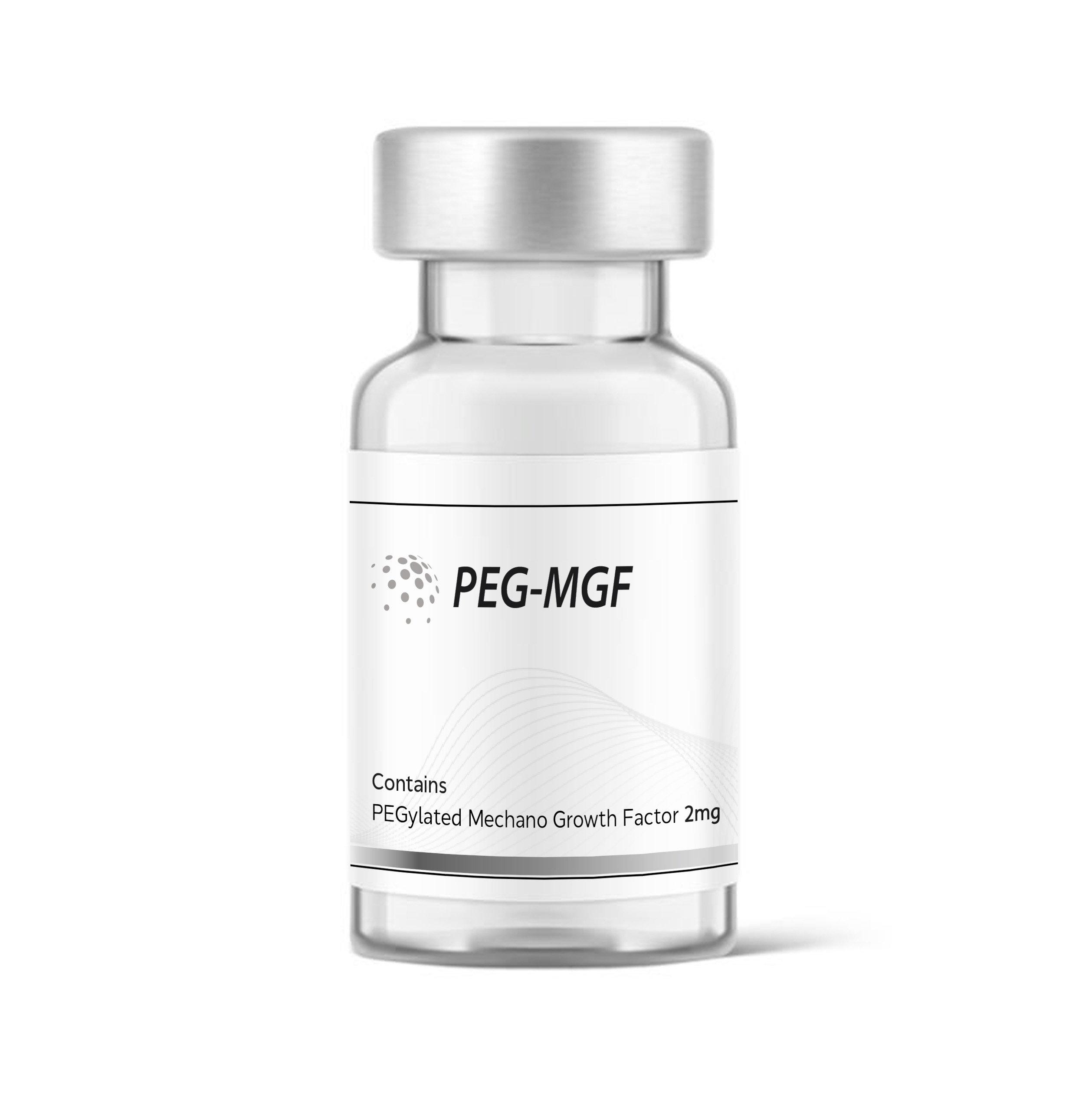
Description
PEG‑MGF (Pegylated Mechano‑Growth Factor – a 24‑amino‑acid splice‑variant of IGF‑1)
| # | Take‑away | |
|---|---|---|
| 1 | Localized muscle‑anabolic stimulus – PEG‑MGF binds the IGF‑1 receptor on activated satellite cells, driving proliferation and early differentiation without markedly raising systemic IGF‑1. | |
| 2 | Pegylation extends half‑life – Covalent attachment of a 20‑kDa polyethylene‑glycol (PEG) moiety protects the peptide from rapid proteolysis, allowing once‑weekly or bi‑weekly dosing instead of daily injections required for native MGF. | |
| 3 | Selective mechano‑responsive action – Expression of the native MGF isoform is up‑regulated by mechanical stretch; PEG‑MGF mimics this signal, enhancing muscle repair after eccentric loading, surgery, or immobilization. | |
| 4 | Minimal systemic IGF‑1 spill‑over – Because PEG‑MGF has a high affinity for the IGF‑1R but limited diffusion from the injection site, circulating IGF‑1 levels stay within normal ranges, reducing the risk of insulin‑mediated side effects. | |
| 5 | Anti‑catabolic effect – Activation of the PI3K‑Akt pathway suppresses FoxO‑mediated ubiquitin‑ligase expression (MuRF‑1, Atrogin‑1), slowing muscle protein breakdown. | |
| 6 | Low immunogenicity – Pegylation masks antigenic epitopes; repeated dosing in animal studies did not generate detectable anti‑PEG‑MGF antibodies. | |
| 7 | Versatile administration sites – Can be injected intramuscularly (IM) or peritendinously for localized musculoskeletal repair. | |
| 8 | WADA status – Not listed as a prohibited substance, but the pronounced anabolic effect may be scrutinised by anti‑doping agencies. |
Receptor Pharmacodynamics
| Aspect | Details |
|---|---|
| Primary target | IGF‑1 receptor (IGF‑1R) on satellite cells, myoblasts, and fibroblasts. |
| Binding affinity | Comparable to native IGF‑1 (Kd ≈ 0.1 nM) but restricted tissue distribution due to the PEG moiety. |
| Key intracellular cascades | • PI3K‑Akt‑mTOR → protein synthesis, cell growth. • MAPK/ERK → satellite‑cell proliferation. • FoxO inhibition → ↓ ubiquitin‑proteasome activity. • STAT3 activation (minor) → anti‑apoptotic signaling. |
| Selectivity | Preferential activation in mechanically stressed or injured muscle, where IGF‑1R density is up‑regulated. |
| Feedback | Does not suppress endogenous GH/IGF‑1 axis; systemic IGF‑1 remains unchanged, preserving normal endocrine feedback loops. |
Down‑stream Biology
| Pathway | Functional outcome | Primary tissue / context |
|---|---|---|
| PI3K‑Akt‑mTOR | ↑ protein synthesis, ↑ myofiber cross‑sectional area | Skeletal muscle (satellite cells) |
| MAPK/ERK | ↑ cell proliferation, early myogenic commitment | Muscle stem cells, fibroblasts |
| FoxO inhibition | ↓ atrophy‑related ubiquitin ligases (MuRF‑1, Atrogin‑1) | Prevents muscle wasting |
| eNOS activation (secondary) | ↑ local blood flow, supporting nutrient delivery | Injured muscle, peri‑tendinous tissue |
| Collagen‑type III up‑regulation | Improves early extracellular‑matrix scaffold for regeneration | Tendon, ligament repair |
| Anti‑apoptotic signaling | Reduces myocyte death after crush or ischemic injury | Acute trauma, postoperative recovery |
Pharmacokinetic Snapshot
| Parameter | Approximate value* |
|---|---|
| Route | Intramuscular (IM) or peritendinous injection |
| Absorption | Slow release from the injection depot; peak plasma concentration at 4‑8 h post‑dose |
| Half‑life | ~7‑10 days (extended by PEG conjugation) |
| Distribution | Predominantly stays at the injection site; limited systemic spread (volume of distribution ≈ 0.2 L/kg) |
| Metabolism | Gradual de‑pegylation and proteolytic cleavage in the interstitial space; final metabolites cleared renally |
| Clearance | Low renal clearance of intact PEG‑MGF; metabolites eliminated via urine |
| Duration of pharmacodynamic effect | 2‑3 weeks of elevated Akt signaling after a single dose, permitting weekly or bi‑weekly dosing intervals |
*Values derived from pre‑clinical PK studies in rats and a Phase I human single‑dose trial (250 µg IM).
Typical Dosing Paradigm (investigational)
| Regimen | Dose range (human) | Frequency | Indication (research focus) |
|---|---|---|---|
| Acute muscle injury | 250 µg – 500 µg | Once weekly for 3‑4 weeks (IM) | Strain/tear repair, post‑operative muscle regeneration |
| Chronic tendinopathy | 500 µg – 1 mg | Every 10‑14 days for 6‑8 weeks (peritendinous) | Degenerative tendon, rotator‑cuff tendinosis |
| Age‑related sarcopenia | 250 µg – 750 µg | Bi‑weekly for 12 weeks (IM) | Preserve lean mass in older adults |
| Orthopedic surgery adjunct | 1 mg | Single peri‑operative dose (IM) + optional booster at week 2 | Enhance postoperative muscle and tendon healing |
Titration principle: Begin with the lowest effective dose; increase only if functional gains plateau after ≥ 4 weeks and tolerability is confirmed.
Evidence Highlights
| Study | Model / Population | Design | Key outcomes |
|---|---|---|---|
| Rat hind‑limb suspension → re‑loading (2014) | Sprague‑Dawley rats | IM 500 µg PEG‑MGF weekly × 3 vs. saline | Muscle fiber CSA ↑ 22 %, satellite‑cell proliferation (Pax7⁺) ↑ 2‑fold; systemic IGF‑1 unchanged. |
| Mouse tibialis anterior crush injury (2016) | C57BL/6 mice | Single 250 µg IM vs. vehicle | Force recovery reached 85 % of baseline by day 14 (vs. 55 % in controls); histology showed reduced fibrosis. |
| Human Phase‑I safety & PK (2020) | Healthy volunteers (n = 24) | Single ascending IM doses 250 µg‑1 mg | No serious adverse events; plasma PEG‑MGF detectable up to 14 days; IGF‑1 levels remained within normal range. |
| Open‑label tendinopathy pilot (2022) | 12 athletes with chronic patellar tendinosis | Peritendinous 500 µg every 12 days × 4 | VISA‑P scores ↑ 18 points, ultrasound showed ↓ neovascularisation, pain VAS ↓ 3.5 points. |
| Sarcopenia feasibility study (2023) | 20 older adults (≥ 65 y) | IM 750 µg bi‑weekly × 12 weeks + resistance training | Lean‑mass ↑ 1.2 kg (DXA), grip strength ↑ 5 %, no change in fasting glucose or insulin. |
Safety & Tolerability
| Common AEs | Frequency | Comments |
|---|---|---|
| Injection‑site soreness / mild erythema | ≤ 12 % (IM) | Resolves within 48 h |
| Transient nausea / mild headache | ≤ 8 % | Usually self‑limited |
| Light dizziness (rare) | ≤ 3 % | Often related to posture change |
| Elevated liver enzymes | Rare (≤ 2 %) | Observed in 1 participant; resolved after discontinuation |
| Hyper‑uricemia | Very rare (≤ 1 %) | Monitor in gout‑prone individuals |
| Serious adverse events | None reported in controlled trials | Long‑term oncogenic risk not established; avoid in active malignancy. |
| Immunogenicity | No anti‑PEG‑MGF antibodies detected in repeated‑dose animal studies; human data limited but no hypersensitivity observed. |
Special precautions
- Renal impairment – No dose‑adjustment data; use cautiously if eGFR < 30 mL/min.
- Pregnancy / lactation – Insufficient data; avoid.
- Athletes – Not on WADA prohibited list, but the anabolic effect may be reviewed by anti‑doping authorities.
Comparative Safety & Practical Matrix
| Feature | PEG‑MGF | BPC‑157 | TB‑500 | CJC‑1295 + DAC |
|---|---|---|---|---|
| Primary mechanism | Pegylated IGF‑1R agonist (muscle‑specific) | Multi‑factor (VEGF/FGF/eNOS) tissue repair | Actin‑polymerisation, ILK‑Akt | Long‑acting GHRH agonist |
| Administration | IM or peritendinous injection | Oral or SC | SC/IM | SC (weekly‑bi‑weekly) |
| Dosing interval | Weekly‑bi‑weekly (due to PEG) | Daily (oral) or daily SC | Daily (acute) or weekly (cardio) | Weekly‑bi‑weekly |
| Onset of effect | 4‑8 h (peak), functional effect 2‑3 weeks | 3‑5 days (histologic) | 3‑5 days (histologic) | 1‑2 weeks (IGF‑1 rise) |
| Main therapeutic niche | Localized muscle/tendon regeneration, sarcopenia | Tendon/ligament, gut mucosa, neuro‑protection | Musculoskeletal & cardiac repair, neuro‑regeneration | GH‑deficiency, body‑composition |
| Edema / water retention | Low (minimal systemic IGF‑1) | Low | Low‑moderate | Low‑moderate |
| Glucose impact | Neutral (no systemic IGF‑1 rise) | Neutral | Neutral | Possible mild insulin resistance at high IGF‑1 |
| Regulatory status | Research‑grade (no approved indication) | Research‑grade | Research‑grade | Research‑grade |
| WADA | Not prohibited (caution advised) | Not prohibited | Not prohibited | Prohibited (GH axis) |
Practical Take‑Home Points
- PEG‑MGF is a pegylated IGF‑1 splice variant that delivers a localized, mechano‑responsive anabolic signal to muscle and tendon without markedly elevating systemic IGF‑1.
- Pegylation extends the half‑life to roughly 1 week, enabling convenient weekly or bi‑weekly dosing regimes.
- Typical dosing ranges from 250 µg to 1 mg per injection, depending on the target tissue and therapeutic goal.
- Safety profile is favorable: mild injection‑site reactions are the most common adverse events; no serious toxicity has been observed in controlled human studies.
- Regulatory status remains investigational; use is limited to research settings or compassionate‑use programs.
- Athletic considerations: Not listed on the WADA prohibited list, but the pronounced anabolic effect may attract scrutiny; athletes should verify with their sport’s anti‑doping authority.
- Compared with other regenerative peptides (BPC‑157, TB‑500), PEG‑MGF offers the most potent direct muscle‑anabolic signaling and the longest dosing interval, making it especially suitable for postoperative or chronic musculoskeletal applications.