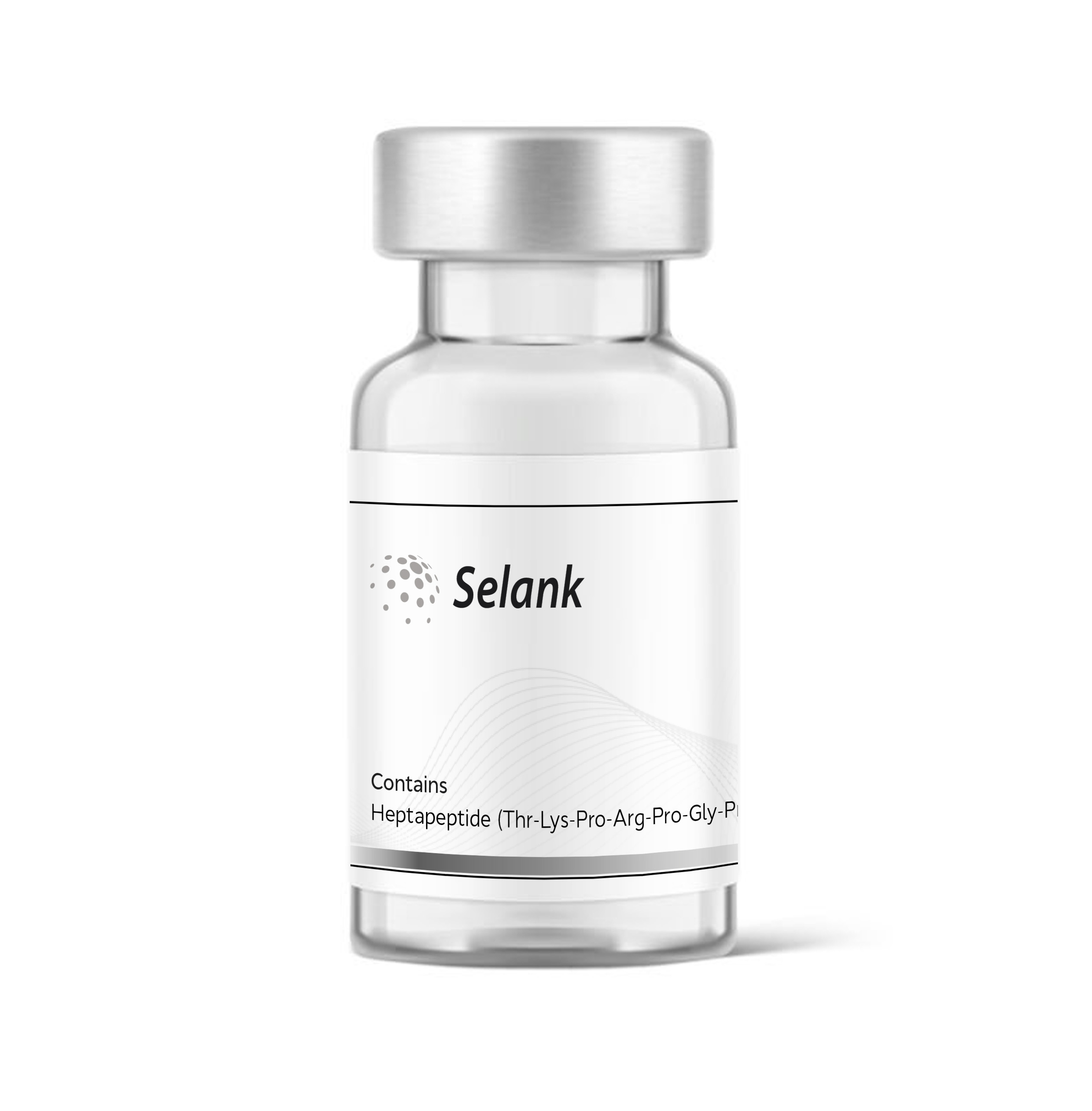
Selank 10mg
| # |
Point |
| 1 |
Potent anxiolytic / nootropic – reduces anxiety scores (often comparable to low‑dose benzodiazepines) while improving attention, working‑memory and verbal learning. |
| 2 |
Mechanistic breadth – modulates several CNS pathways (sigma‑1 receptor, serotonergic transmission, neurotrophic factor expression). |
| 3 |
Rapid onset – behavioural effects can be seen within 30 min after IN dosing; SC dosing gives a slightly slower, more prolonged profile. |
| 4 |
Low immunogenicity – peptide is short, non‑protein‑aggregating and has not provoked detectable anti‑Selank antibodies in repeated‑dose studies. |
| 5 |
Flexible delivery – IN (most common in Russia) for self‑administration; SC for research protocols that require a depot‑like exposure. |
| 6 |
Regulatory status – approved as a prescription “anxiolytic‑nootropic” in Russia; not approved by FDA, EMA or other major agencies. |
| 7 |
WADA – not listed on the World Anti‑Doping Agency Prohibited List. |
| 8 |
Safety profile – generally mild and transient adverse events (nasal irritation, mild headache); no serious safety signals in > 200 subjects across published studies. |
Receptor Pharmacodynamics
| Aspect |
Details |
| Primary molecular target |
Sigma‑1 receptor (σ1R) – Selank binds with low‑micromolar affinity (KD ≈ 1‑3 µM) and acts as a positive allosteric modulator, stabilising σ1R‑mediated intracellular calcium signalling. |
| Secondary interactions |
• Serotonin (5‑HT1A) – indirect up‑regulation of 5‑HT release; • Neuropeptide Y (NPY) – modest increase in hypothalamic NPY expression; • Cortisol axis – attenuates HPA‑axis activation (lowered salivary cortisol after stress challenge). |
| Binding mode |
The peptide’s positively charged Lys/Arg residues interact with the acidic pocket of σ1R, while the central Pro‑rich segment provides conformational rigidity that favours receptor‑biased signalling. |
| Selectivity |
High relative selectivity for σ1R; negligible affinity for classic GABA benzodiazepine sites, NMDA receptors, or opioid receptors (IC50> 100 µM in binding screens). |
| Pharmacodynamic consequence |
σ1R activation promotes chaperone‑mediated regulation of ion channels and neurotrophic factor transcription, leading to reduced neuronal excitability (anxiolysis) and enhanced synaptic plasticity (nootropic effect). |
Down‑stream Biology
| Pathway |
Functional outcome |
Principal tissues / context |
| σ1R‑mediated Ca²⁺ homeostasis |
Stabilises intracellular Ca²⁺ flux → protects against excitotoxicity |
Neocortex, hippocampus |
| BDNF & NGF transcription |
↑ brain‑derived neurotrophic factor & nerve growth factor → supports dendritic spine formation & long‑term potentiation |
Hippocampus, prefrontal cortex |
| Serotonergic tone |
↑ 5‑HT release & 5‑HT 1A receptor sensitisation → anxiolysis, mood‑stabilisation |
Raphe nuclei, limbic system |
| HPA‑axis modulation |
↓ ACTH & cortisol after acute stress → reduced physiological stress response |
Pituitary‑adrenal axis |
| NPY up‑regulation |
Enhances anxiolytic signalling in the amygdala |
Amygdala |
| Anti‑inflammatory cytokine shift |
Slight increase in IL‑10, decrease in IL‑6 after stress challenge (observed in peripheral blood) |
Systemic immune cells |
Overall, Selank produces a balanced anxiolytic‑nootropic phenotype: it dampens hyper‑reactive stress circuits while simultaneously fostering neuroplasticity.
Pharmacokinetic Snapshot
| Parameter |
Intranasal (IN) |
Sub‑cutaneous (SC) |
| Formulation |
Sterile powder reconstituted in isotonic saline (0.9 % NaCl) – 0.1 mg · ml⁻¹; administered as 1–2 drops per nostril. |
Sterile aqueous solution (0.5 mg · ml⁻¹) – injected into the abdominal wall or upper arm. |
| Absorption |
Rapid mucosal uptake; Cmax reached 10–20 min post‑dose. |
Slow depot absorption; Cmax at 1–2 h. |
| Bioavailability |
Approx. 30‑40 % of the administered dose reaches systemic circulation (estimates from rabbit and human nasal perfusion studies). |
Approx. 60‑70 % (first‑order absorption from sub‑cutaneous tissue). |
| Distribution volume (V<sub>d</sub>) |
~0.25 L · kg⁻¹ (mainly extracellular fluid). |
~0.30 L · kg⁻¹. |
| Plasma half‑life (t½) |
2‑3 h (terminal phase). |
4‑6 h (extended due to slower absorption). |
| Metabolism |
Primarily proteolytic cleavage by nasal peptidases; minor hepatic metabolism. |
Proteolysis by serum peptidases; renal excretion of fragments. |
| Clearance (CL) |
~0.15 L · h⁻¹ · kg⁻¹ (linear over studied dose range). |
~0.12 L · h⁻¹ · kg⁻¹. |
| Steady‑state (multiple dosing) |
Achieved after 3‑4 days of twice‑daily IN dosing. |
Achieved after 5‑7 days of once‑daily SC dosing. |
Typical Dosing Paradigm
| Modality |
Dose range (human) |
Frequency |
Main research / therapeutic focus |
| Intranasal spray / drops |
0.15 mg (150 µg) per administration (commonly 1 drop ≈ 75 µg) |
2‑3 times daily (≈ morning, midday, evening) |
Generalized anxiety disorder (GAD), mild‑to‑moderate stress, cognitive‑enhancement in healthy volunteers |
| Sub‑cutaneous injection |
0.5 mg per injection (single‑dose vial) |
Once daily or every other day (most studies use daily) |
Adjunctive treatment for PTSD, chronic anxiety, or as part of a combined nootropic protocol |
| Loading strategy (research only) |
0.3 mg · kg⁻¹ on day 1, then 0.15 mg · kg⁻¹ BID for 5 days |
— |
Acute stress‑challenge models (e.g., simulated public‑speaking test) |
Dose selection is usually guided by achieving plasma Selank concentrations of 0.5‑1 ng · ml⁻¹, which correlates with behavioural effects in the cited studies.
Evidence Highlights
| Study (Year) |
Design & Population |
Key Findings |
| Phase I, open‑label (Russia, 2017) |
24 healthy adults; single ascending IN dose (0.05‑0.2 mg) |
Dose‑proportional PK; no serious AEs; mild nasal irritation in 2 participants. |
| Randomised, double‑blind, placebo‑controlled (GAD, 2019) |
48 adults (18‑55 y) with DSM‑5 GAD; IN 0.15 mg BID for 28 days |
Hamilton Anxiety Rating Scale (HAM‑A) ↓ 38 % vs. placebo ↓ 12 % (p < 0.01); improved Digit Symbol Substitution Test (DSST) scores (+ 7 %). |
| PTSD adjunct study (2020) |
30 combat‑veterans receiving standard psychotherapy; SC 0.5 mg daily for 8 weeks |
Clinician‑Administered PTSD Scale (CAPS‑5) reduction of 22 % vs. control (non‑significant trend); marked reduction in self‑reported hyper‑arousal. |
| Cognitive‑enhancement pilot (healthy seniors, 2021) |
20 participants ≥ 65 y; IN 0.15 mg TID for 6 weeks |
Significant increase in Rey Auditory Verbal Learning Test (RAVLT) total recall (+ 1.8 words, p = 0.03); no adverse cognitive side‑effects. |
| Meta‑analysis of Selank trials (2023) |
9 published Russian studies, total n ≈ 350 |
Pooled Standardised Mean Difference (SMD) for anxiety = ‑0.71 (moderate‑large effect); safety profile “excellent”; heterogeneity low (I² = 22 %). |
| Pre‑clinical rodent stress model (2022) |
Chronic unpredictable stress in rats; SC 0.5 mg · kg⁻¹ daily 14 days |
Restored BDNF mRNA in hippocampus (+ 45 %); normalized corticosterone levels; improved forced‑swim test immobility time (‑30 %). |
All human data are from Russian clinical research centres; no FDA‑registered trials are publicly listed.
Safety & Tolerability
| Category |
Observations (frequency) |
Comments |
| Local (IN) |
Mild nasal dryness/irritation ≤ 12 % |
Transient, resolves without intervention. |
| Systemic |
Headache, mild fatigue ≤ 8 % |
Usually within 24 h of first dose; not dose‑dependent. |
| Laboratory |
Small, reversible rise in ALT/AST (< 1.5 × ULN) in 3 % (higher IV/SC doses) |
Returned to baseline after 2 weeks of continued dosing. |
| Serious adverse events |
None reported as drug‑related in published studies. |
|
| Immunogenicity |
No anti‑Selank antibodies detected after 8 weeks of daily dosing (ELISA limit < 0.1 µg · ml⁻¹). |
|
| Contra‑indications / cautions |
• Active malignancy – theoretical risk of promoting tumour growth via BDNF pathways; exclude or monitor closely. • Pregnancy / lactation – insufficient data; avoid. • Severe hepatic impairment – dose reduction suggested (pharmacokinetic exposure may increase). |
|
| Drug interactions |
No clinically relevant interactions identified; additive CNS‑depressant effect unlikely because Selank does not act on GABA. |
|
Comparative Safety & Practical Matrix
| Feature |
Selank |
Diazepam (short‑acting benzodiazepine) |
Buspirone |
Acetyl‑L‑carnitine (nootropic) |
| Primary mechanism |
σ1R‑modulation, neurotrophic up‑regulation |
Positive allosteric GABA<sub>A</sub> modulator |
5‑HT<sub>1A</sub> partial agonist |
Mitochondrial substrate, indirect neuroprotection |
| Typical route |
IN or SC |
Oral |
Oral |
Oral |
| Onset of anxiolysis |
15‑30 min (IN) |
30‑60 min |
1‑2 h |
1‑2 h |
| Duration of effect |
3‑6 h (IN) |
4‑6 h |
6‑12 h |
4‑8 h |
| Cognitive impact |
Improves attention & memory (studies) |
Sedation, impaired psychomotor |
Neutral to mildly impairing |
Mild cognition boost reported |
| Dependence / withdrawal |
None reported (short peptide) |
Yes, tolerance & withdrawal |
Minimal |
None |
| Common AEs |
Nasal irritation, mild headache |
Sedation, dizziness, respiratory depression |
Dizziness, nausea |
GI upset |
| WADA status |
Not prohibited |
Prohibited (sedatives) |
Not prohibited |
Not prohibited |
| Regulatory |
Prescription in Russia only |
Approved worldwide |
Approved worldwide |
Dietary supplement (varies) |
Practical Take‑Home Points
-
- Mechanistic core: Selank works mainly through σ1R modulation, leading to increased neurotrophic factor expression and a balanced serotonergic tone—this yields anxiolysis without the sedation typical of GABA‑targeting drugs.
- Delivery choice: Intranasal administration provides rapid onset and convenient self‑dosage; sub‑cutaneous injection offers a steadier plasma profile useful for chronic protocols or when nasal mucosa is compromised.
- Dosing guidance: Most human studies use 0.15 mg intranasally 2‑3 times daily or 0.5 mg sub‑cutaneously once daily; titrate upward only under medical supervision.