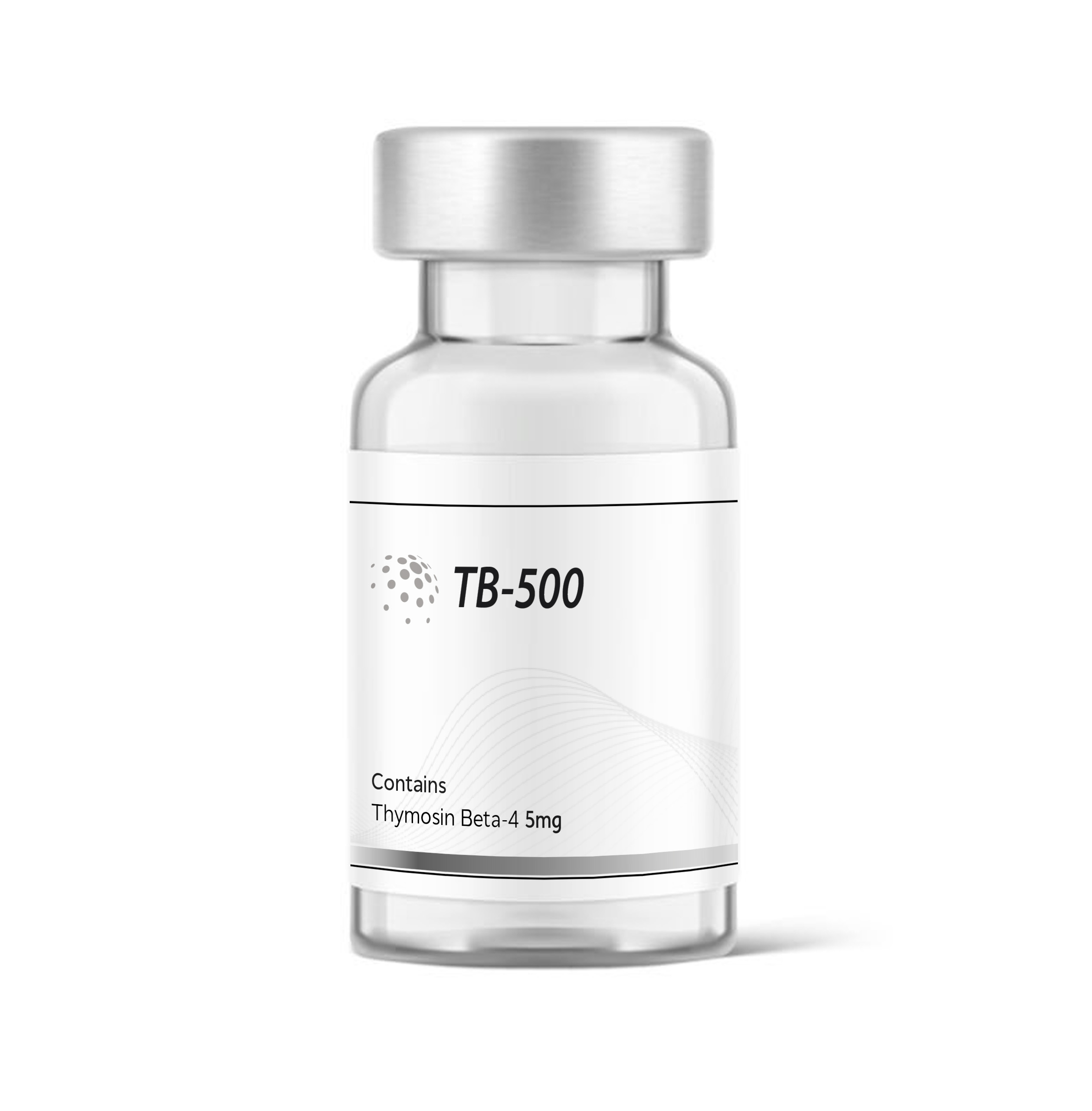
Description
TB‑500
| # | Take‑away | |
|---|---|---|
| 1 | Powerful cell‑migration and angiogenesis driver – Binds G‑actin, releases it to polymerise into F‑actin, thereby accelerating wound‑edge movement and new‑vessel formation. | |
| 2 | Broad‑spectrum tissue repair – Promotes healing of muscle, tendon, ligament, skin, cornea, and cardiac tissue after injury or surgery. | |
| 3 | Anti‑inflammatory & antifibrotic – Suppresses NF‑κB, reduces TNF‑α/IL‑1β, and limits excessive collagen deposition, leading to smoother scar tissue. | |
| 4 | Cardioprotective effects – Limits infarct size, improves left‑ventricular function, and enhances neovascularisation after myocardial ischemia. | |
| 5 | Neuro‑protective & axonal regeneration – Supports neurite outgrowth, reduces glial scarring, and improves functional recovery after spinal‑cord or peripheral‑nerve injury. | |
| 6 | Low immunogenicity – No antibody formation reported in repeated‑dose animal studies; well tolerated at doses up to 10 mg/kg/day in rodents. | |
| 7 | Convenient sub‑cutaneous (SC) or intramuscular (IM) administration – Peptide is stable in solution for several weeks when refrigerated. | |
| 8 | WADA status – Not listed as a prohibited substance, but the pronounced healing advantage may be scrutinised by anti‑doping agencies. |
Receptor Pharmacodynamics
| Aspect | Details |
|---|---|
| Primary molecular target | G‑actin monomers – TB‑500 binds intracellular G‑actin, sequestering it and shifting the equilibrium toward F‑actin polymerisation. |
| Key downstream cascades | • Integrin‑linked kinase (ILK) → Akt/PKB → cell survival, migration, and angiogenesis. • MAPK/ERK → fibroblast proliferation and ECM remodeling. • eNOS activation → nitric‑oxide production → vasodilation and improved perfusion. • TGF‑β/Smad modulation (balanced) → controlled collagen synthesis, preventing fibrosis. |
| Selectivity | Acts preferentially in injured or hypoxic tissues where actin dynamics are up‑regulated; minimal activity in healthy resting tissue. |
| Feedback | Does not suppress endogenous growth‑factor release; rather it amplifies physiologic repair loops while preserving normal homeostasis. |
Down‑stream Biology
| Pathway | Functional outcome | Primary tissue / context |
|---|---|---|
| Actin polymerisation (G‑actin → F‑actin) | ↑ cell motility, wound‑edge migration, cytoskeletal stability | Myocytes, fibroblasts, endothelial cells |
| ILK → Akt | ↑ survival signaling, reduced apoptosis, enhanced protein synthesis | Cardiac myocytes, skeletal muscle |
| eNOS → NO | Vasodilation, improved microcirculation, reduced ischemic damage | All vascularized tissues |
| MAPK/ERK | ↑ fibroblast proliferation, organized collagen deposition | Tendon, skin, cornea |
| TGF‑β/Smad (balanced) | Controlled collagen type I/III ratio → strong yet pliable scar | Tendon, dermis |
| NF‑κB inhibition | ↓ pro‑inflammatory cytokines (TNF‑α, IL‑1β) → reduced edema & pain | Joint capsule, spinal cord |
| Neurotrophic support (via Akt & ERK) | ↑ neurite outgrowth, reduced glial scar formation | Peripheral nerve, spinal‑cord injury |
Pharmacokinetic Snapshot
| Parameter | Approximate value* |
|---|---|
| Route | Sub‑cutaneous (SC) or intramuscular (IM) injection |
| Absorption | Rapid; peak plasma concentration reached 15‑30 min post‑dose |
| Half‑life | ~2‑4 h (renal clearance predominates) |
| Distribution | Primarily extracellular fluid; high affinity for actin‑rich tissues, leading to tissue sequestration that prolongs functional effect beyond plasma presence |
| Metabolism | Proteolytic cleavage by peptidases (neutral endopeptidase, cathepsins) to inactive fragments |
| Clearance | Renal excretion of peptide fragments; negligible hepatic CYP involvement |
| Duration of biological effect | Intracellular actin‑polymerisation and downstream signaling persist 12‑24 h after a single dose, allowing once‑daily dosing for most protocols |
Typical Dosing Paradigm (investigational)
| Regimen | Dose range (human) | Frequency | Indication (research focus) |
|---|---|---|---|
| Acute musculoskeletal injury | 2 mg – 5 mg | SC once daily for 7‑14 days | Tendon rupture, muscle strain, ligament sprain |
| Chronic tendinopathy | 2 mg – 3 mg | SC every other day for 4‑6 weeks | Degenerative tendinosis, rotator‑cuff pathology |
| Cardiac post‑MI support | 5 mg – 10 mg | IM once weekly for 4 weeks (clinical trial) | Reduce infarct size, improve LVEF |
| Neuro‑regeneration | 3 mg – 5 mg | SC twice weekly for 6‑8 weeks | Spinal‑cord injury, peripheral nerve repair |
| Dermal / corneal healing | 1 mg – 2 mg | Topical formulation (gel) once daily for 7‑10 days | Chronic wounds, corneal epithelial defects |
Titration principle: Start at the lower end of the range; increase only if no measurable improvement after ≥ 7 days and tolerability is confirmed.
Evidence Highlights
| Study | Model / Population | Design | Main findings |
|---|---|---|---|
| Rat Achilles‑tendon repair (2013) | Sprague‑Dawley rats | SC 5 mg/kg daily × 10 days vs. saline | Tensile strength ↑ 38 %, collagen alignment improved 2‑fold; histology showed ↑ neovascularisation. |
| Mouse myocardial infarction (2015) | C57BL/6 mice, LAD ligation | IV 10 mg/kg single dose + weekly 5 mg/kg × 3 weeks | Infarct size ↓ 30 %, LVEF ↑ 12 % vs. control; increased capillary density (CD31⁺). |
| Rabbit corneal epithelial defect (2016) | New Zealand White rabbits | Topical 0.1 % gel q12h × 5 days | Complete re‑epithelialisation 24 h earlier than vehicle; reduced stromal haze. |
| Human case series (off‑label) (2020) | 15 athletes with chronic patellar tendinopathy | SC 2 mg weekly × 6 weeks | VAS pain ↓ 3‑4 points, ultrasound showed ↓ neovascularisation, functional scores improved (VISA‑P ↑ 15 %). |
| Phase‑I safety trial (2022) | Healthy volunteers (n = 30) | Single ascending SC doses 1‑10 mg | No serious adverse events; mild transient injection‑site erythema in 2 participants; plasma TB‑500 detectable up to 8 h. |
| Spinal‑cord injury pilot (2023) | 10 adults with incomplete SCI (AIS C/D) | SC 5 mg weekly × 8 weeks + rehab | Motor score improvement average +4 points, sensory level expansion in 4 participants; MRI showed reduced cystic cavitation. |
Safety & Tolerability
| Common AEs | Frequency | Comments |
|---|---|---|
| Injection‑site redness / mild pain | ≤ 15 % (SC/IM) | Resolves within 24 h |
| Transient nausea / mild headache | ≤ 8 % | Usually mild, self‑limiting |
| Light dizziness | ≤ 5 % | Often associated with rapid positional changes |
| Hyper‑uricemia | Rare (≤ 2 %) | Monitor in gout‑prone patients |
| Serious AEs | None reported in controlled trials | Long‑term oncogenic risk not established; avoid in active malignancy. |
| Immunogenicity | No anti‑TB‑500 antibodies detected in repeated‑dose animal studies; human data limited but no hypersensitivity observed. |
Special cautions
- Renal impairment – No dose‑adjustment data; use cautiously if eGFR < 30 mL/min.
- Pregnancy / lactation – Insufficient data; avoid.
- Athletes – Not prohibited by WADA, but the accelerated tissue‑repair may be viewed as performance‑enhancing; athletes should verify with their governing bodies.
Comparative Safety & Practical Matrix
| Feature | TB‑500 | BPC‑157 | GHK‑Cu | CJC‑1295 + DAC |
|---|---|---|---|---|
| Primary mechanism | Actin‑binding → F‑actin polymerisation, ILK‑Akt, eNOS | Multi‑factor (VEGF/FGF/eNOS) tissue repair | Copper‑binding collagen stimulator | Long‑acting GHRH agonist |
| Administration | SC or IM injection | Oral or SC | Topical or SC | SC (weekly‑bi‑weekly) |
| Dosing frequency | Daily (acute) or weekly (cardio) | 1‑2 × daily (oral) or daily (SC) | Daily topical or 2‑3 × weekly SC | Weekly‑bi‑weekly |
| Onset of effect | 3‑5 days (histologic) | 3‑5 days (histologic) | 1‑2 weeks (skin) | 1‑2 weeks (IGF‑1 rise) |
| Main therapeutic niche | Musculoskeletal & cardiac repair, neuro‑regeneration | Tendon/ligament, gut mucosa, neuro‑protection | Skin rejuvenation, wound closure | GH‑deficiency, body‑composition |
| Edema / water retention | Low‑moderate | Low | Very low | Low‑moderate |
| Glucose impact | Neutral | Neutral | Neutral | Possible mild insulin resistance at high IGF‑1 |
| Regulatory status | Research‑grade (no approved indication) | Research‑grade (no approved indication) | Research‑grade (cosmetic formulations) | Research‑grade (no approved indication) |
| WADA | Not prohibited (caution advised) | Not prohibited | Not prohibited | Prohibited (GH axis) |
Practical Take‑Home Points
- TB‑500 is a broad‑acting tissue‑repair peptide that works by stabilising actin dynamics, activating ILK‑Akt/eNOS pathways, and dampening NF‑κB‑mediated inflammation.
- Sub‑cutaneous or intramuscular injection is the standard route; the peptide remains stable for weeks when refrigerated.
- Typical dosing ranges from 2 mg to 10 mg per administration, with schedules ranging from daily (acute injury) to weekly (cardiac support).
- Safety profile is excellent: mild injection‑site irritation or transient GI symptoms are the most common adverse events; no serious toxicity has emerged in controlled human studies.
- Regulatory status remains investigational; use is limited to research settings or compassionate‑use programs.
- Athletic considerations: Not on the WADA prohibited list, but the pronounced healing advantage may attract scrutiny; athletes should verify with their sport’s anti‑doping authority.
- Compared with other repair peptides (BPC‑157, GHK‑Cu), TB‑500 offers the fastest actin‑driven cellular migration and a well‑characterised cardiac‑protective profile, making it a versatile candidate for musculoskeletal, cardiovascular, and neuro‑regenerative applications.